


The Ultimate Guide to Welding Fume Extraction: Everything You Need to Know for a Safer Shop
In industrial manufacturing, welding is a core process that presents significant air quality challenges. Welding fumes are a complex mixture of metallic oxides, silicates, and fluorides. When a welder strikes an arc, the intense heat vaporizes the metal and consumables, creating sub-micron particles that stay suspended in the air. For shop managers, controlling these emissions is not just a matter of cleanliness: it is a critical requirement for OSHA compliance and worker safety.
Effective air filtration requires a strategic approach to ventilation and specialized equipment. Whether your facility utilizes manual MIG/TIG stations or high-volume robotic cells, selecting the right welding fume extractor is essential for maintaining operational efficiency and reducing long-term health risks.
Understanding the Risks of Welding Fumes
The composition of welding fumes varies depending on the base metal, the filler material, and the welding process used. Common hazardous components include Hexavalent Chromium (found in stainless steel welding), Manganese, Nickel, and Lead. Prolonged exposure to these airborne contaminants can lead to serious respiratory issues, including occupational asthma and pneumonitis.

Beyond health concerns, uncontrolled fumes impact the facility's bottom line. Fine particulate matter can infiltrate sensitive CNC electronics, settle on finished products, and increase the frequency of general building maintenance. By implementing a dedicated industrial dust collector or fume extraction system, facilities can prevent these operational bottlenecks.
Primary Fume Extraction Methodologies
There is no one-size-fits-all solution for welding ventilation. The layout of your shop, the size of the workpieces, and the frequency of welding operations dictate which extraction method is most effective.
1. Source Capture (Local Exhaust Ventilation)
Source capture is widely considered the most efficient method for fume control. By capturing contaminants at the point of generation, you prevent them from entering the welder's breathing zone and dispersing throughout the plant.
-
Articulated Extraction Arms: These flexible arms can be positioned directly over the weld. They are typically connected to a centralized vacuum system or a mobile unit.

XA Wall Mount Extraction Arms | Parker Hannifin
- Fume Extraction MIG Guns: Specialized torches integrate extraction ports directly into the shroud. These require a minimum airflow of approximately 100 CFM to be effective but offer the highest level of mobility for the welder.
- Downdraft Tables: Ideal for small-to-medium parts, these tables pull smoke and dust downward through a grated work surface into a built-in welding fume extractor.
2. Ambient Air Filtration
In facilities where overhead cranes or large workpieces make source capture impractical, ambient systems are used. These systems continuously cycle the air in the shop, passing it through high-efficiency filters to lower the overall concentration of fumes. This approach is often paired with source capture to manage "stray" fumes that escape local hoods.
3. Hood Collection
Common in robotic welding cells, fixed hoods enclose the workspace to confine fumes. These hoods are connected to high-capacity ductwork and a centralized industrial dust collector.
Types of Welding Fume Extraction Systems
Choosing the right equipment depends on the mobility requirements and the volume of welding performed. Kogi Environmental Solutions provides a range of products designed for various industrial applications.
Fixed Centralized Systems
For shops with dedicated welding bays, a centralized system is the most cost-effective long-term solution. A single high-capacity fan and filter unit, such as those from Parker Hannifin or A.C.T. Dust Collectors, can service multiple stations. These systems often utilize large banks of dust collector filters and can be equipped with variable frequency drives (VFDs) to optimize energy consumption based on the number of active stations.
Mobile Fume Extractors
Portable units offer flexibility for maintenance welding or shops with changing layouts. These "plug-and-play" machines include a built-in fan, filtration system, and extraction arm. They are ideal for light-to-medium duty applications where a fixed installation is not feasible.
Electrostatic Precipitators (ESP)
In applications where welding produces heavy oil smoke or when air is being recirculated to save on heating and cooling costs, an electrostatic precipitator is often the preferred technology. Systems like the Smog-Hog use an ionization process to charge particles, which are then collected on oppositely charged plates. Unlike traditional media filters, ESP cells can be cleaned and reused, reducing the ongoing cost of replacement filters.
Robotic vs. Manual Welding Considerations
The extraction requirements for robotic welding differ significantly from manual operations. In manual welding, high-vacuum systems (often requiring 50 inches of water column pressure) are needed to pull fumes through long, flexible hoses.
Conversely, robotic systems can operate efficiently with lower vacuum pressure (as low as 20 inches of water column) because the extraction kits can be mounted with fewer obstructions. When designing a system for a robotic cell, it is critical to ensure the extraction timing matches the arc-on time to maximize capture efficiency without wasting energy.

Maintenance and Efficiency for Shop Managers
The performance of any welding fume extractor is only as good as its maintenance schedule. A neglected system leads to decreased suction, higher energy bills, and non-compliance with OSHA PELs (Permissible Exposure Limits).
Filter Management
The heart of any mechanical extraction system is the filter media. Most modern industrial dust collectors use pleated cartridge filters. These should be monitored via differential pressure gauges. A sudden rise in pressure indicates that the filters are loaded and require pulse-cleaning or replacement. Using high-quality dust collector filters with the correct MERV rating ensures that even sub-micron particles are captured before the air is exhausted or recirculated.
System Performance Evaluation
Regular inspections should include:
- Ductwork Checks: Inspect for "settling" in the ducts, which occurs if the transport velocity is too low.
- Fan Integrity: Ensure the blower is operating at the designed RPM.
- Seal Inspection: Check gaskets and access doors for leaks that could bypass the filtration media.
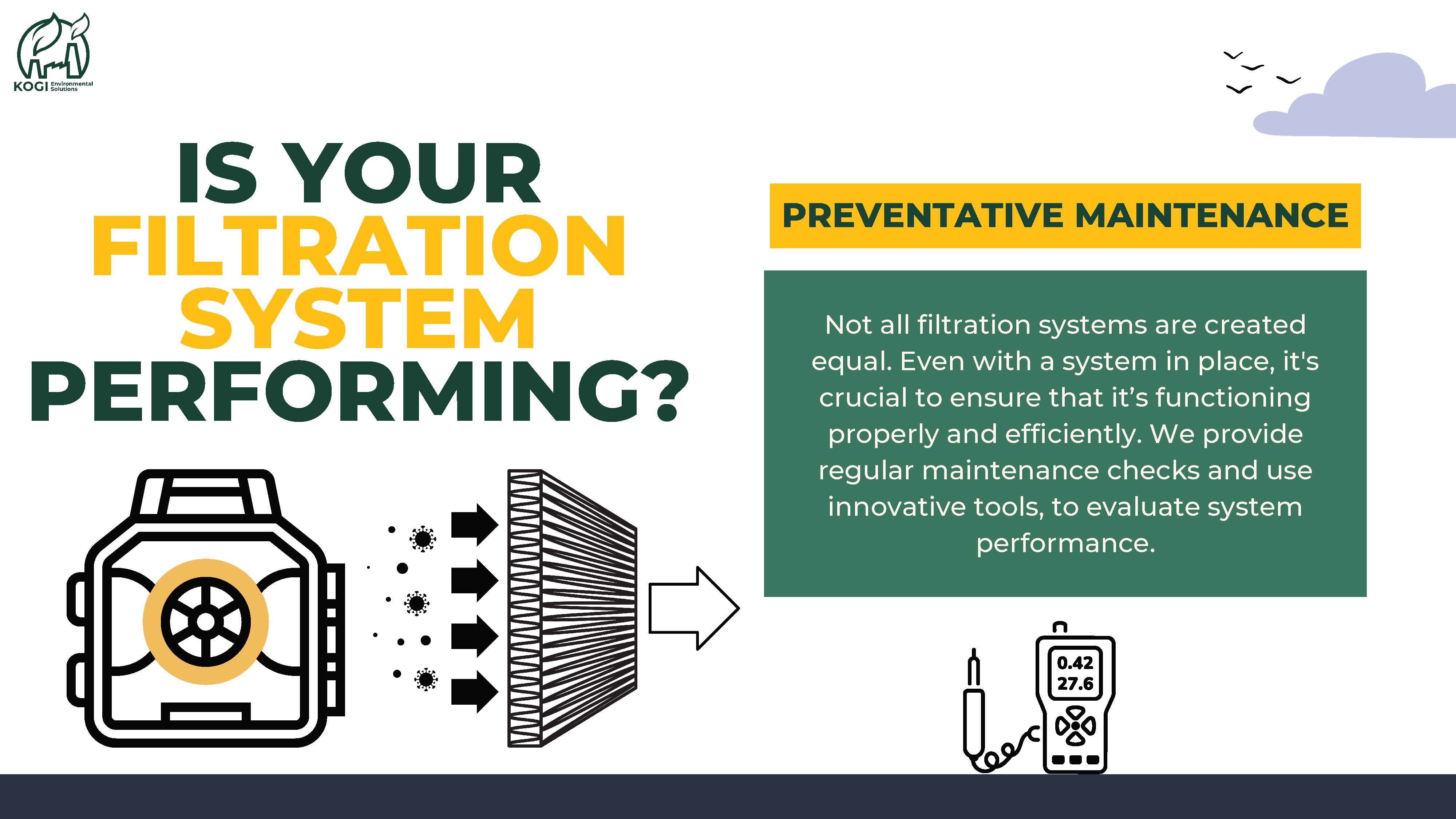
Kogi Environmental Solutions offers services specifically designed to evaluate system performance and provide preventative maintenance to keep your shop running at peak efficiency.
OSHA Compliance and Safety Standards
OSHA’s Chromium (VI) standard (29 CFR 1910.1026) and the Manganese PEL requirements are stringent. Shop managers must prove that worker exposure levels stay below the established limits. Implementing a robust fume extraction system is the most effective engineering control to meet these standards.
In addition to respiratory safety, managers must consider the fire risks associated with welding dust. Fine metallic dust can be combustible. Systems should be evaluated for NFPA compliance, which may include the installation of spark arrestors, fire suppression systems, or explosion venting depending on the materials being welded.
Selecting the Right Solution for Your Facility
When evaluating a new fume extraction project, consider the following technical specifications:
- Airflow (CFM): Ensure the fan can handle the static pressure of the ductwork and filters while maintaining the required face velocity at the capture point.
- Filtration Efficiency: For hexavalent chromium or other toxic metals, HEPA-grade secondary filtration may be required.
- Footprint: Mobile units save floor space in tight shops, while centralized units are often located outdoors or on mezzanines.
For expert guidance on selecting the right equipment: from mist collectors for machining to heavy-duty dust collector filters: our team at Kogi Environmental Solutions can provide a site visit and technical assessment. Contact us today to discuss your facility's specific air quality needs.
By prioritizing source capture and rigorous maintenance, industrial shop managers can create a safer, more efficient environment that protects both their employees and their equipment. Whether you are upgrading an existing line or building a new fabrication suite, the right extraction technology is the foundation of a modern, compliant shop.